


The first time Trisha got her period, she thought something was wrong.
No one had explained what was happening. In South Khurushkul Union of Cox’s Bazar, menstruation was not something girls talked about. It was whispered about, hidden, and often misunderstood. Like many girls in her village, Trisha felt fear instead of understanding, and shame instead of support.
Meghla and Arpita had similar experiences. They remember trying to figure things out on their own, using whatever materials were available, worrying about stains, and staying quiet even when they had questions. In their community, silence surrounded menstruation.
Everything began to change when HYSAWA’s Community Organizers started visiting their village. They invited girls to sit together in courtyard sessions and talk openly about Menstrual Hygiene Management, or MHM.

At first, the girls avoided eye contact. Theygiggled nervously. Some kept their heads down. But the organizers spoke gently and clearly. They explained that menstruation is natural. They answered questions. They challenged harmful myths. Most importantly, they listened.
Slowly, the silence began to break.
“We never knew we could speak about this without feeling ashamed,” Arpita says softly. “Now we understand our bodies. We feel confident.”
Since 2008, HYSAWA has been working across rural Bangladesh to ensure that girls and women can manage their menstruation 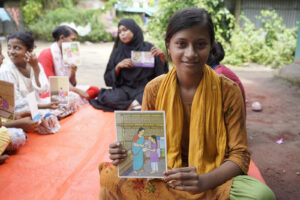 safely and with dignity. Beyond education, the organization supports the installation of private MHM chambers in household latrines, safe, clean spaces where women and girls can care for themselves comfortably.
But real change goes beyond facilities. HYSAWA also works with parents, teachers, religious leaders, and local authorities to shift attitudes and challenge stigma. When a community understands, a girl no longer has to hide.
Each year on Menstrual Hygiene Day, hygiene kits filled with sanitary napkins and soap are distributed to girls in schools and villages. For many, it is more than just a package. It is reassurance that they are seen, supported, and valued.
Today, Trisha, Meghla, and Arpita sit in those courtyard sessions with their heads held high. They ask questions. They share what they have learned with younger girls. The fear they once felt has been replaced with knowledge. The shame has been replaced with pride.
In a village where menstruation was once a secret, these girls are now voices of change.
Case study collected by Mostafa Mohammad Tahan, Media & Communication Officer, HYSAWA, February 2026.