
Increase coverage of safe water supply services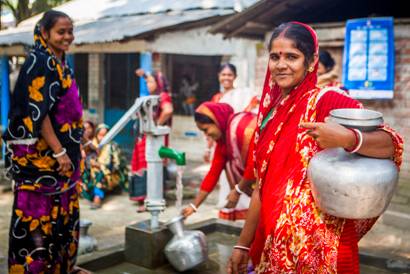
Creation of new access to safe water was the main agenda of this output. HYSAWA focused its attention on hard-core and poor people in the process of approval and ensuring participation by the community in the planning and implementation. About 44% beneficiaries are from hard-core poor population. The needs assessment and planning for additional water and sanitation facilities were done by the community groups (hereinafter termed CDF). In the composition of CDF, the poor and the women were proportionately represented. Gender related issues were particularly given priority in the selection of sites for WatSan infrastructure.
Alternative Water Technologies
Hand pump tube-wells are not feasible in many parts of the country, especially in the coastal belts, rocky soil areas such as Manikgonj and parts of Sylhet and Chittagong and also in Khulna region. To supply water to these areas, HYSAWA has promoted alternative technologies which include:
- sky-hydrants
- deep-set hand pump
- piped water supply
- rain water harvesting systems
- dug wells and
- pond sand filters
Currently, HYSAWA is looking into options for setting-up reverse osmosis plants in areas where salinity is too high. A total of 309 water sources, using these alternative technologies have been approved and installed in such areas.
Water Quality Testing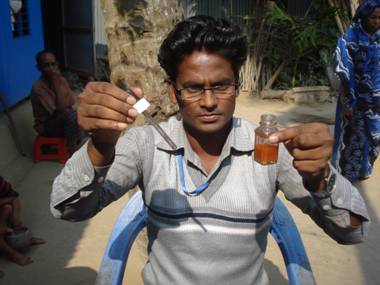
Good water quality is the ultimate objective when searching for sources of water. Testing water quality for key elements such as arsenic, chloride, iron and manganese is mandatory for HYSAWA interventions; it is also a milestone for payment of the 2nd installment to contractors.
In response to the absence of physical and laboratory facilities to test water quality in different project areas, HYSAWA has begun to conduct water quality testing at the water point site. The use of field testing kits at the water point using scientifically acceptable methods can be accepted as substitute for laboratory tests.
Operation and Maintenance
Operation and maintenance is essential for sustainability of installed infrastructures, especially the water supply schemes. HYSAWA facilitated and financed training of local mechanics to be able to fix problems on call. For routine and minor maintenance one male and one female user from each water point are trained and provided a set of tools. About 100,000 people were given such training. This large force in the community will provide regular information for water safety, especially on hand washing, water collection, preservation and consumption.
Quality Control of WatSan Infrastructure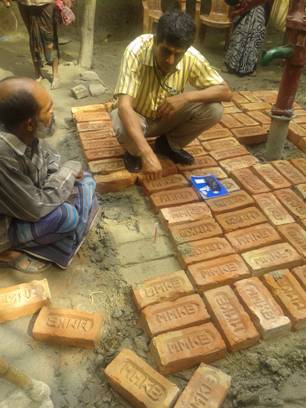
HYSAWA has built-in quality control mechanisms for every stage of implementation of hardware activities. The quality control process is described below.
Support to Tender Processing at UP level: Tender evaluation Committee members were oriented on PPR procedures including invitation of tenders, evaluation etc.
Pre-qualification of suppliers and contractors: Qualified District based uPVC pipe and tube-well head manufacturers, suppliers and contractors are enlisted for HYSAWA through third party.
During installation: Approved sites for water points are strictly maintained and can only be changed by a resolution reached in a community meeting. Location of water points monitored through site visits. Demonstrations and information on quality materials are provided to the CDF before installation, including the requirement for lab testing of pipes. On-site supervision during installation of tube wells to monitor quality of equipment and materials, boring depth, joint of pipes, pump development, discharge of TW, and platform quality