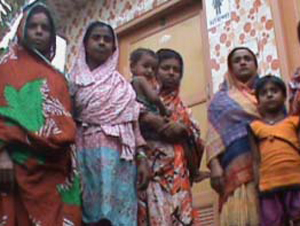

“We are hand-to-mouth people, but we can claim that we have one great luxury that many rich people do not have, it is our latrine” said Aklima, a housewife dwelling in the slums of Rupsha Majhir Ghat. Her neighbours, Al-Amin, Kali Sikder, Sultan, Rina, Minara, Moyna, Monwara and many others supported her while she was making this statement.
The slum is in Naihati Union, Rupsha Upazila of Khulna district. Rupsha Ghat was named after the Rupsha River and is a well-known place in Khulna. Thousands of people cross the river through this Ghat every day. There are lots of fish -processing industries around this Ghat turning the area into a buzzing work place for hundreds of people every day – some work at the fish processing industries, some pull rickshaw vans while others work as transport workers and boatmen.
These low-income groups live in the slums around the Ghat. The slum of Rupsha Majhirghat is one which is largely inhabited by the boatmen. More than 500 people live in an area of about 200 square meters. For drinking water they depended on a shallow tube well affected by Arsenic. For other purposes they used river water which was also polluted. The habitants were relying on hanging latrines. With HYSAWA’s financing, the UP installed 18 stand posts from a nearby piped water supply system. Crisis for safe drinking water was thus overcome. For want of space, individual households could not construct their household latrines. So, strategically, two communal (shared) latrines have been installed, one with two chambers and another with four chambers, both having separate facilities and entrance for male and female users. Besides, intensive hygiene promotion sessions were conducted on hand-washing and use of latrines.
HYSAWA funded 15 such communal latrines throughout the project area in Khulna region. The community takes care of maintenance by forming a committee and collecting monthly nominal charges from each family to cover the cleaning costs. Community volunteers educate the users on personal and latrine hygiene. The people of Majhir Ghat are now very satisfied. Women, particularly who had to wait for the dark hours to attend to nature’s call, have now found a comfortable place to go to when they need it.
“Our children will now grow up in a clean environment and have less chance of becoming sick from poor sanitation and water borne diseases,” Aklima said confidently.