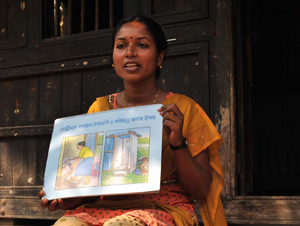

“I am proud to be a volunteer and promoter of hygiene, sanitation and water supply project of Sriramkathi Union. This role has given me additional respect in the community,” Shulata Majumder, a 23-year old volunteer from Sriramkathi Union, enlisted under HYSAWA Fund, expressed her excitement while talking to us in the field. The volunteers are selected on the basis of their acceptance by the community, their willingness to spare time and their basic level of education. The best performing volunteers are often given awards in kind. Shulata has also been awarded once for her performance.
Shulata is a college graduate and have been engaged with this work for over eight months. She proudly said she had made 100% sanitation coverage among 20 families she is responsible for. One tube well was installed by the UP with HYSAWA Fund for these families but is not enough, she pointed out. Working alongside her male counterparts, Shulata organizes monthly community meetings and provides practical training on hand-washing, menstrual hygiene, food hygiene and safe use of water. With an audience consisting of mothers and children, Shulata’s training uses BCC materials such as posters, flip chart, flash cards and Ludu. Video shows and street dramas are also being planned. Shulata said women of her community now can access water within a short distance whereas in the past they used to cross the canal to fetch water, a task that cost them at least two hours a day. She aspires to have one more tube well in her community. The community has already identified, with her help, where the next tubewell might be installed.
In HYSAWA funded programmes, there are, on an average, 100 such volunteers in each Union totaling to more than 40,000, of which more than 50% are women. They work during flexible hours purely on voluntary basis without any payment. These volunteers have received training on hygiene, sanitation and water supply from community workers and PNGOs engaged by the Union following the government procurement procedure. The ultimate objective is to leave behind trained volunteers in the community to sustain these promotional activities when the project inputs are phased out.
Shulata aspires to be a teacher in future and wants to teach children the things that she learned through her involvement in these activities. “Children are future parents and if they learn hygiene, sanitation and water use, they can then bring about these changes in their own children and that’s how life will change” she confirms.