
Living in cities, most of us take basic necessities such as running water, electricity etc. for granted. And although a lot of the modern facilities are now widespread in rural Bangladesh, safe water is still a far-fetched reality for thousands & lakhs. Women in rural Bangladesh still walk for 30 minutes to 2 hours daily to fetch water for drinking purposes; as for daily purpose, it is more convenient for them to use ponds, rivers or arsenic affected water points.
One of the main objectives of HYSAWA is to bring safe water points closer to people with hardest access, hoping to make their lives a little easier, a little safer. This story is about a community who managed to do something extra with all the time they now save from not carrying water from a distance.
Dokkhin (or South) Biddyanandi is one of the villages in Hossainpur union’s ward no. 6. The union is under Rajor Upazila in Madaripur. Kumarbari or potter community resides just next to a river stream and they are one of the communities to have received a deep tube well from HYSAWA. Previously, they used river water for every aspect apart from drinking purposes. Each woman from every household walked for at least 20 minutes to fetch drinking water from the nearest deep tube well.
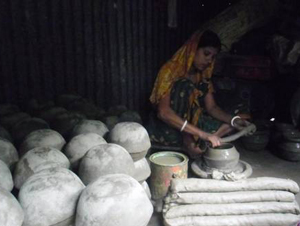
Extra_income.JPGBut, since the tube well from HYSAWA, life has changed for the better. Around 12 families directly use this tube well, and another 10 families come from nearby households. Both the men & women of this community are extremely happy. The men are happy because now they don’t have to travel back & forth to the river for molding their clay; and the women are happy because they have a little extra time for themselves. But since it is a potter community, there is always something to do. We caught the women kneading clay, molding on the necks to dried pots etc. When asked, they informed that because of the tube well so close to them, they are able to wrap up their domestic work soon and able to help out their husbands with pottery making. Dulal Pal, one of the members of this community said, “now that the women are able to help out, business is good. We take out finished goods more quickly than before. And they also feel empowered that they are able to contribute to income. When the tube well came, we knew it would make life easier for the women, never really expected the bonus!”
Case study collected by Nusrat Daud Pritha,Consultant, Documentation Officer, HYSAWA, October 2014